


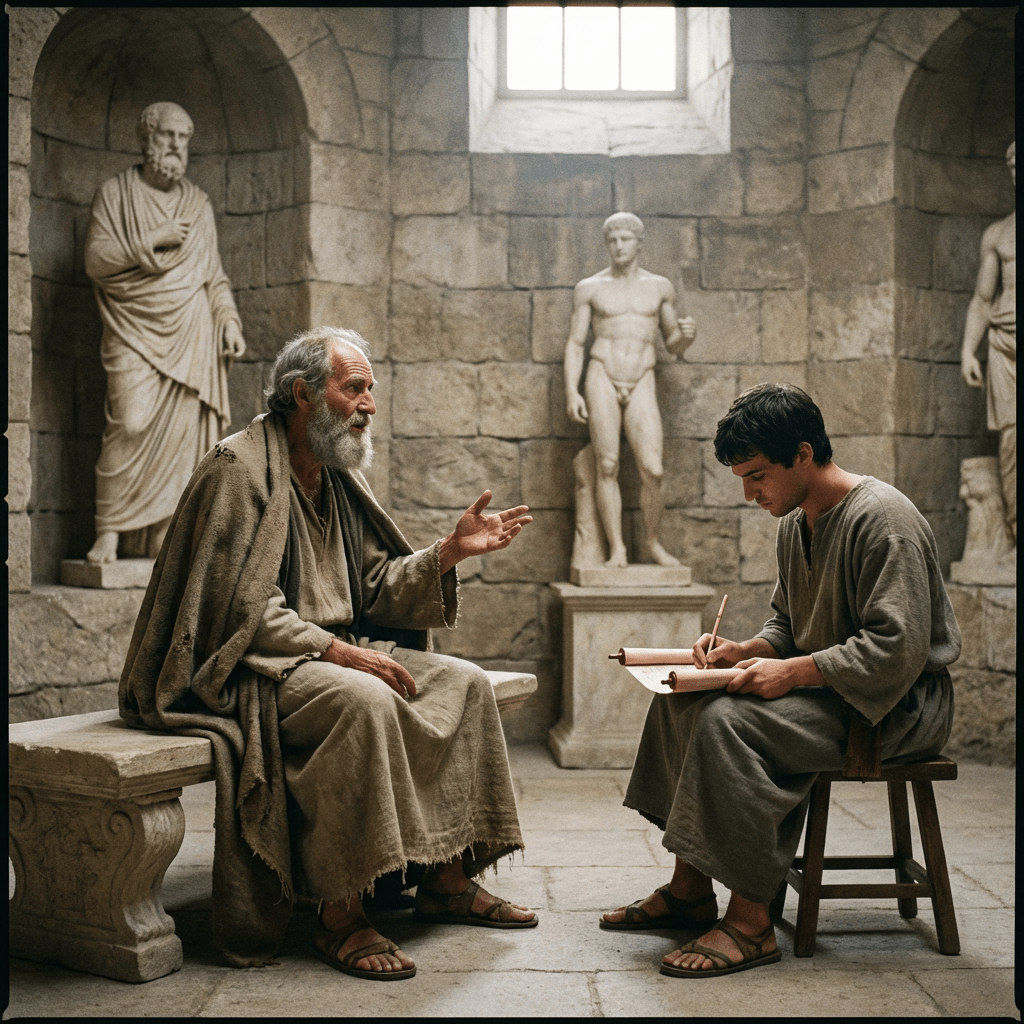
When we go to the movies, we take note of the genre, knowing that action, comedy, and drama each set different expectations. Imagine the confusion on a date: expecting a romantic comedy, you end up seeing a horror film instead! Ancient genres go beyond simple labels; they include physical and rhetorical conventions partly shaped by the amanuensis (the secretary that wrote by dictation). Romans, for instance, reflects both dictation through an amanuensis and the rhetorical use of diatribe (arguing with an imaginary opponent). Both of these conventions suggest oral dictation and an intention to deliver orally.
This fits the broader Greco-Roman context in which Paul was writing, when many works were composed for oral performance.¹ Therefore, the Christian communities that encountered these letters generally would not have engaged the text privately, but rather it would have been read aloud within a gathered assembly.² Paul certainly would have anticipated this and thus shaped his writing accordingly. Compare this with how modern Bible study series approach the text, where we might spread one of Paul’s letters out over a series of weeks.
In my opinion, this can make Paul’s letters feel disconnected and would be similar to watching a movie ten minutes at a time, once a week, until it is finished! For this reason, I think listening to a good dramatic audio Bible can help clarify Paul’s argument.
I think it is reasonable to assume that Paul intended for his arguments to be followed in real time, with little interruption aside from occasional clarification. With shifts in tone, emphasis, and imagined objections, the message becomes clearer in oral delivery. This understanding helps modern readers recover something of the text’s original experience.
These aspects would affect both the composition and the reception of the letter, as Paul may have trusted his companion with some degree of freedom in choosing the letter’s exact wording.³ This background matters because Paul is not writing alone in solitary confinement, but alongside a trusted companion. His words are shaped through dictation, collaboration, and final authorial approval. This reflected the literary culture of the day, in which the author’s preliminary drafts would be reviewed by others and refined⁴, but only the final draft would be circulated.⁴
Secondly, Romans reflects the use of diatribe, where a teacher raises an objection in the voice of an imaginary interlocutor.⁵ Paul uses this method throughout Romans (e.g., Rom 3:1–4; 6:1–2; 9:14), often responding with μὴ γένοιτο. This second, imaginary voice has a somewhat dramatic quality and can be further emphasized by the reader. If someone is unaware of the convention, they may misunderstand Paul as defending something he is actually refuting. μὴ γένοιτο!
This is where, I surmise, the conventions of oral dictation and diatribe naturally fit together. Once the letter is understood in this back-and-forth style between two voices, the meaning becomes clearer. Romans should sound like a debate in progress.
Understanding conventions such as the use of an amanuensis and the diatribe convention can help readers interpret Romans or aid preachers in exposition. These conventions demonstrate that Paul’s letter is shaped as an oral argument, explaining its vivid dialogue with imagined opponents.
- Stanley E. Porter and Andrew W. Pitts, Fundamentals of New Testament Textual Criticism (Grand Rapids, MI: Wm. B. Eerdmans Publishing Co., 2015), 45.
- Andrew F. Walls, “The Canon of the New Testament,” in The Expositor’s Bible Commentary: Introductory Articles, ed. Frank E. Gaebelein, vol. 1 (Grand Rapids, MI: Zondervan Publishing House, 1979), 637.
- D. A. Carson and Douglas J. Moo, An Introduction to the New Testament, 2nd ed. (Grand Rapids, MI: Zondervan, 2005), 334–35.
- Porter and Pitts, Fundamentals of New Testament Textual Criticism, 48.
- John D. Grassmick, “Epistolary Genre: Reading Ancient Letters,” in Interpreting the New Testament Text: Introduction to the Art and Science of Exegesis, ed. Darrell L. Bock and Buist M. Fanning (Wheaton, IL: Crossway Books, 2006), 235.
 J. C. Walz – Faith, Fiction, and DEvotional Writing
Leave a comment