


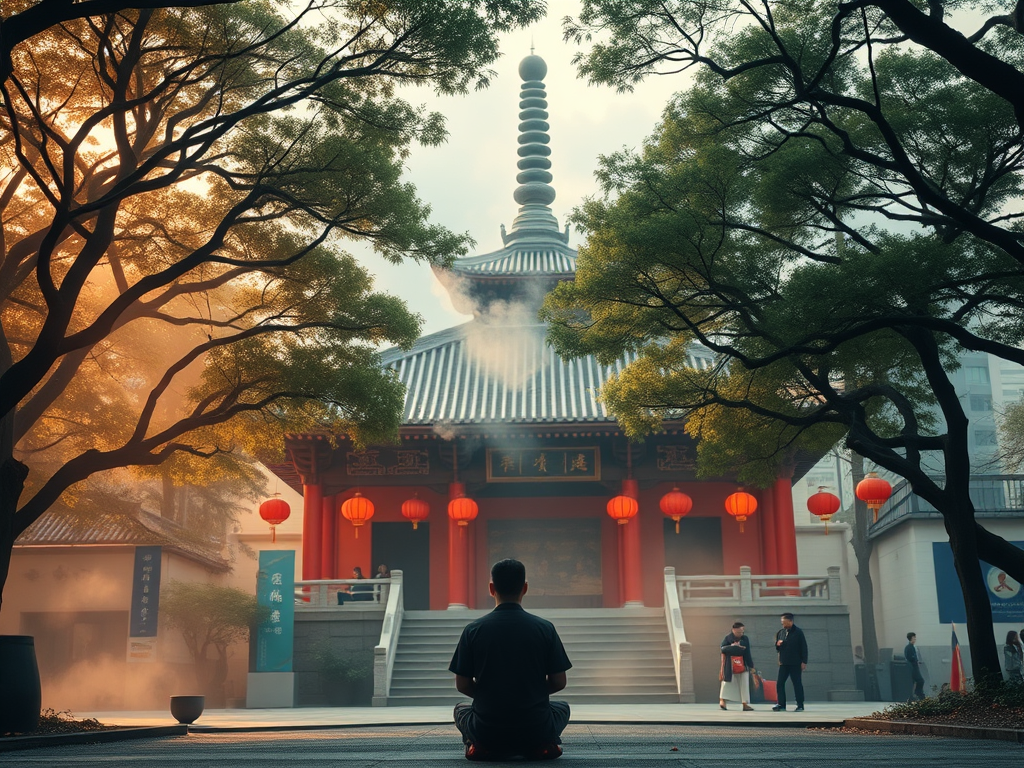
Where do people find peace when they are troubled? Where does Taiwan look for rest when anxiety lingers?
Some visit temples after hearing that a particular god seemed to help someone else. Incense is burned, prayers are offered, and a measure of calm settles the heart. Others consult fortune tellers when life feels unstable. An answer is given, and the sense of closure produces temporary relief. Some seek peace through relationships, entertainment, or business, because staying busy can silence inner noise for a time. A Buddhist approach often recommends loosening one’s grip on craving and attachment, since suffering is understood as bound up with desire, and peace is sought through release.²
Yet a serious question remains. If the peace fades, was the problem truly solved?
Revelation 21 addresses that question by taking the reader to the end of the biblical story. The One who speaks there declares, “I am the Alpha and the Omega, the beginning and the end” (Rev. 21:6). This is not the claim of an impersonal force but of a personal and sovereign God who stands at the origin and conclusion of all things. If that claim is true, then the Bible is not merely a helpful religious perspective. It is presenting reality on God’s own authority.
Verse 1 opens with a sweeping vision: “And I saw a new heaven and a new earth: for the first heaven and the first earth were passed away” (Rev. 21:1). God’s answer to human anxiety is not simply a temporary improvement within the present order. It is the replacement of the present order itself. The first heaven and first earth pass away, along with everything bound up in their corruption, sorrow, and decay. This is not a coping strategy. It is renewal at the deepest level of reality.
For those who ask, “Is this just life? Will fear and unrest always return?” the text answers with hope that is larger than the cycle of temporary relief. In verse 5, the One seated upon the throne declares, “Behold, I make all things new” (Rev. 21:5). History is moving toward restoration.
Verse 2 adds another image: “the holy city, new Jerusalem… prepared as a bride adorned for her husband” (Rev. 21:2). The language intentionally blends place and relationship. A city appears, yet it is described like a bride, pointing beyond architecture to covenant intimacy. What is coming down from God is not merely a location but a prepared reality for communion with Him.
That emphasis becomes explicit in verse 3: “Behold, the tabernacle of God is with men, and he will dwell with them” (Rev. 21:3). The problem behind our lack of peace is not simply imbalance in impersonal energies. Scripture frames it as separation between God and humanity. Human beings were made in God’s image to dwell with Him, yet something ruptured that relationship. The Bible names it sin.
This is where the question of temporary peace becomes sharper. If the root problem is relational and moral, then temporary calm cannot resolve it.
Verse 4 moves from announcement to consolation: “And God shall wipe away all tears from their eyes; and there shall be no more death, neither sorrow, nor crying, neither shall there be any more pain: for the former things are passed away” (Rev. 21:4). Notice the finality. No more death. No more sorrow. No more pain. These are not merely reinterpreted as natural features of the universe. They are abolished. Death is treated as an enemy that will be removed.
Here the Bible diverges from many common ways people in Taiwan talk about suffering and death. In some popular forms of Eastern thought, including practices such as feng shui that aim to harmonize the flow of qi for well-being and prosperity, death is often viewed as part of the natural order.¹ In Buddhism, suffering is described in the Four Noble Truths as inherent to conditioned existence and rooted in craving, with liberation understood as the cessation of that suffering.² Revelation 21 does not advise detachment. It promises eradication. Sorrow and death belong to an old order that is passing away.
Verse 5 then underscores the certainty of this hope: “Write: for these words are true and faithful” (Rev. 21:5). Hope without guarantee is fragile, but this promise rests on the character of the One who sits on the throne.
Revelation 21 also confronts human guilt. Verse 8 lists categories of sin that describe the world we live in, and the hearts we know: “the fearful, and unbelieving… and all liars” (Rev. 21:8). The list is uncomfortable because it is recognizable. This is another reason temporary peace cannot last. Ritual may soothe, divination may reassure, distraction may numb, and even moral self-improvement may offer a sense of progress. None of these erase guilt. None of these cancel the debt of sin.
Yet in the midst of warning comes invitation. In verse 6 the Lord declares, “I will give unto him that is athirst of the fountain of the water of life freely” (Rev. 21:6). Thirst is the acknowledgment of need. Anxiety, fear, and restlessness may be signals that something deeper is unresolved. The promise is not self-generated enlightenment but life given by God.
Freely does not mean without cost. It means the cost has already been borne. Scripture reveals that Jesus Christ is the guarantor of this promise, because through His death and resurrection He pays the debt sinners cannot pay. The debt of sin is not balanced through ritual or neutralized through indifference. It is paid.
Verse 7 summarizes the promise: “He that overcometh shall inherit all things; and I will be his God, and he shall be my son” (Rev. 21:7). This is more than inner tranquility. It is restored relationship, secured inheritance, and belonging to God Himself.
So we return to the question. If inner peace lasts only a little while, was the problem actually solved?
If sin remains unforgiven, it was not. If death remains undefeated, it was not. If the relationship with God remains broken, it was not.
Revelation 21 presents peace that does not evaporate because it addresses the root of human unrest. God makes all things new. He removes death. He dwells with His people. He offers the water of life freely to the thirsty. Lasting peace is not found in balancing forces or quieting desire, but in reconciliation with the Alpha and the Omega.
- Encyclopaedia Britannica, s.v. “Feng Shui,” accessed February 15, 2026, https://www.britannica.com/art/fengshui.
- Mark Siderits, “Buddha,” Stanford Encyclopedia of Philosophy, accessed February 15, 2026, https://plato.stanford.edu/entries/buddha/.
 J. C. Walz – Faith, Fiction, and DEvotional Writing
Leave a comment