


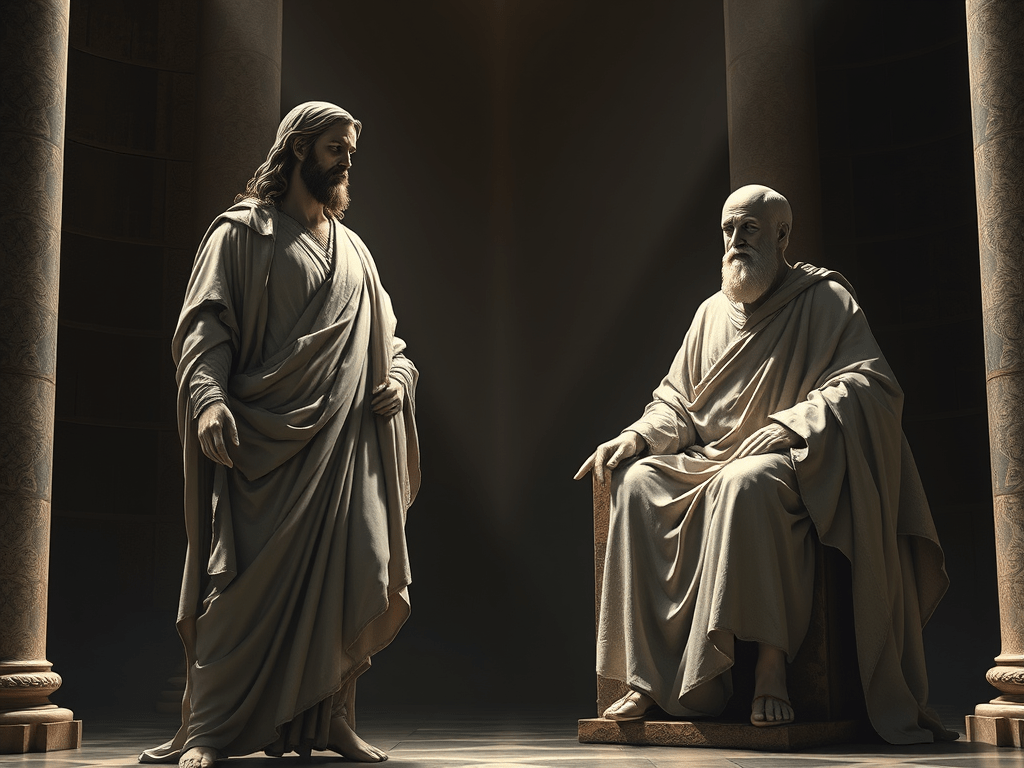
The Consequences of Ignoring the Truth
Does truth comfort us, or does it correct us?
That question matters, because truth that only comforts us can be admired and ignored. But truth that corrects us demands a response. And when truth corrects us, refusing to decide is not neutrality. It is a decision.
Many injustices are not caused by people who love evil, but by people who know what is right and choose silence.
An innocent coworker is blamed, and others who know the truth stay quiet.
A child is treated unfairly, and adults see it but avoid involvement.
A dishonest practice benefits many, and no one speaks because peace feels more valuable than honesty.
A false accusation spreads, and people know it is wrong, but do nothing.
Family conflict harms someone, and silence feels easier than truth.
Indifference feels harmless, maybe even harmonious. But when truth is known, silence is never neutral.
That is not just a social problem. It is a spiritual one.
Jesus Before Pilate: Truth on Trial
When Jesus was arrested, the Jewish leaders had already decided what they wanted. They issued orders that anyone who knew where Jesus was should report Him. Judas took that opportunity and betrayed Him. Jesus was arrested, but the Jewish authorities could not lawfully put Him to death. So they brought Him to the Roman governor, Pilate, accusing Him of sedition and claiming that He called Himself a king.
Pilate took one look at Jesus and did not believe the charge. Jesus did not look like a revolutionary. He did not act like a political king. He did not speak like a threat to Rome. Pilate was already irritated by Jewish disputes and wanted the matter out of his hands. So he asked what sounded like a sarcastic question:
“Are you the King of the Jews?”
But Jesus did not respond the way an innocent man trying to escape would. He did not deny political ambition. He did not say the obvious thing that would have secured His release. Instead, He turned the question back on Pilate:
“Are you saying this of yourself, or did others tell it to you about me?”
Jesus forced Pilate to face something deeper. What do you think? Are you judging me based on truth, or repeating what others have said?
Pilate now had a decision to make. He could investigate. He could listen. He could ask who Jesus truly was. Or he could avoid the question altogether.
Indifference to Truth
Pilate chose avoidance.
“Am I a Jew?” he replied. In other words, “This has nothing to do with me. Your people accuse you. This is your issue, not mine. What have you done?”
This is what indifference to truth looks like. Indifferent people do not investigate truth. They reduce claims to labels they can manage.
Just a foreigner.
Just a criminal.
Just a teacher that some people are upset about.
Pilate was not interested in who Jesus was. He was interested in controlling the situation. Politics mattered more than truth.
And our indifference does the same thing.
It is not that we have never heard things about Jesus. It is that we do not want to deal with who He claims to be. We are not mainly concerned with truth. We are concerned with control.
A king with authority over us is not something we can manage. So it becomes easier to dismiss Jesus than to hear Him.
He is just a teacher. If He is just a teacher, I do not need to change.
He is for other people. If He is for other people, I do not need to change.
This is not my issue. If it is not my issue, I do not need to change.
But that is already a decision. Not a neutral one. A decision to reject His kingship.
A Kingdom Without Violence, But Not Without Authority
Jesus answered Pilate again, not with a defense, but with a declaration:
“My kingdom is not of this world.”
Jesus did not say He had no kingdom. He said His authority did not come from this world. If it did, His servants would fight. But His kingdom was not fragile. It did not need defense. It did not depend on Pilate’s verdict.
Pilate’s court was not equipped to judge this King.
Jesus was saying three things clearly. He has authority. His authority is not from this world. And His authority must be accepted or rejected.
Truth Demands a Decision
Pilate pressed once more. “So you are a king then?”
Jesus answered plainly. “You say that I am a king. For this purpose I was born, and for this cause I came into the world—to bear witness to the truth. Everyone who is of the truth hears my voice.”
Pilate replied with a question that has echoed through history:
“What is truth?”
And then he walked away.
Pilate did not deny Jesus. He did not believe Him either. He walked away. And walking away was the decision.
In this story, Jesus is not truly the one on trial. Pilate is. And so are we.
One day, every person will give an account of what they did with Jesus.
Resurrection, Judgment, and Hope
Pilate condemned Jesus. But God overturned the verdict.
The resurrection proves that truth cannot be buried. Kingship cannot be erased. Silence will not be the final word.
So the question remains.
Will you be the Pilate who quietly handed Jesus over?
Or will you be a different Pilate—one who confesses the Truth, no matter the cost?
Because when Truth is known, silence is never neutral.
 J. C. Walz – Faith, Fiction, and DEvotional Writing
Leave a comment